Why electric outboards finally make sense
For most of the last decade, the honest answer to "should I buy an electric outboard?" was "not yet, unless you're a Sunday daysailor on a lake." Energy density was too low, the cost premium over gas was too steep, and a service network barely existed outside the largest marinas in Northern Europe. That has changed faster than the recreational marine press has acknowledged. The 2025–2026 generation of Torqeedo, ePropulsion, and Mercury Avator outboards crosses three thresholds at once: lithium-ion battery density is now high enough that integrated-battery designs deliver real cruising range, costs at the 3hp-equivalent end are within striking distance of gas, and dealer service has spread far enough that a midwest bass boat owner can get warranty work done locally.
What changed is not one thing — it's three things compounding. Battery chemistry is now reliably delivering 250+ watt-hours per kilogram at the cell level. Brushless DC motor controllers have dropped in price by half. And a generation of cruisers who already accept smartphones in the cockpit no longer find Bluetooth telemetry strange — they expect it.
The use cases where electric is now genuinely the right tool, not just the trendy one:
- Tender propulsion for cruising sailboats. A 1kW Torqeedo or ePropulsion delivers an hour of useful range, recharges from the boat's solar overnight, and weighs less than the gas equivalent. No fuel sloshing in a locker, no choke priming after a layup, no spilled gas on the swim platform.
- Auxiliary on small cruising sailboats up to 22 feet. The use pattern is short bursts — leaving the slip, dropping anchor, coming back in — totaling 1–2 hours of motor time per outing. Electric matches that profile almost perfectly.
- Flat-water fishing. Trolling is the canonical electric-outboard win. Silent operation does not spook fish. Mercury Avator 7.5e is built for this market.
- Lake-restricted waters. A growing number of inland lakes — particularly drinking-water reservoirs — now restrict gas outboards entirely. Electric is the only legal option.
Where electric still loses honestly: long-distance offshore cruising under power (you cannot solar-charge fast enough), high-horsepower planing boats over 18 feet, and any use pattern where you might need to refuel quickly mid-day with no shore power available. A 90-minute outing followed by an overnight at a slip with a 15A outlet — that's the home territory. A 5-hour run across the bay with no return-trip charging — that's not.
Where regulation is forcing the issue
Several jurisdictions have started mandating electric or quiet propulsion on protected waters, and the trend is accelerating. Lake Tahoe restricts gas engines on certain shorelines. Many European inland lakes mandate electric-only. Florida's manatee zones increasingly favor quiet propulsion in the small-vessel category. If you boat anywhere with protected wildlife areas, check the local rules — your choice may already be made for you.
Range math — what the marketing numbers actually mean
Every electric outboard ships with a range chart. They are almost always honest at slow speeds and almost always optimistic at fast speeds. Here's what the numbers actually mean once you put the motor on the back of a real boat.
| Motor | Battery | Slow troll (~2 kn) | Half throttle (~4 kn) | Full throttle |
|---|---|---|---|---|
| Torqeedo Travel (1100 W, next-gen) | 1,080 Wh click-on | ~4 hours (at ~3 kn) | ~2 hours (at ~3.8 kn) | ~47–59 min |
| ePropulsion Spirit 1.0 Plus | 1276 Wh integrated | ~6 hours | ~2.5 hours | ~60–75 min |
| Torqeedo Cruise 3.0 | External 24V bank | Depends on bank | ~2–3 hours / kWh | ~45 min / kWh |
| ePropulsion Navy 3.0 Evo | External 48V bank | Depends on bank | ~2.5–3.5 hours / kWh | ~50 min / kWh |
| Mercury Avator 7.5e | 1000 Wh × 1 or 2 | ~3 hours (1 batt) | ~75 min (1 batt) | ~45 min (1 batt) |
Three things are worth pulling out of that table.
Range scales linearly with battery capacity at constant speed. Doubling battery capacity doubles range. This is obvious in theory but underappreciated when reading vendor literature, which often presents range as a single number rather than as a function of throttle. The Spirit 1.0 Plus's 1276Wh battery is about 18 percent bigger than the Torqeedo Travel's standard 1,080Wh pack, and at the same speed on the same boat you should see roughly that 18 percent at every throttle setting.
Power consumption scales as the cube of speed. Going twice as fast does not use twice as much energy. It uses roughly eight times as much. This is hydrodynamic drag, not electric-specific — gas outboards have the same problem, but they hide it in the fuel tank. With electric, the throttle-to-range trade-off is right in front of you on the display. Once you internalize that doubling your speed cuts your range to one-eighth, you start naturally cruising at half throttle and getting four times the range Torqeedo's "1 hour at full throttle" number suggests.
Tender vs sailboat-auxiliary changes everything. A 1kW electric on a 200lb inflatable tender with one person aboard planes easily and consumes power on the optimistic end of the range. The same 1kW on a 22-foot displacement sailboat auxiliary in a chop pushing into wind consumes power on the pessimistic end — sometimes 30–40 percent more than the spec sheet suggests. Vendor range numbers almost always assume the lighter use case.
For range planning, take the vendor's "moderate cruise" figure, cut it by 25 percent, and that's what you actually have in real-world conditions with weather, weight, and wind. If the answer is still enough for your typical outing with reserve, you're fine. If the answer is "barely enough," you're going to be towing somebody back to the dock the first time the wind picks up.
Three top picks, in detail
We looked at five current electric outboards in the 1kW-to-7.5hp-equivalent range — the next-generation Torqeedo Travel (1100 W), Torqeedo Cruise 3.0, ePropulsion Spirit 1.0 Plus, ePropulsion Navy 3.0 Evo, and Mercury Avator 7.5e. The three below are the picks we'd actually recommend; the other two are excellent but serve narrower use cases we'll touch on at the end. Pricing was verified against vendor sites and major US marine retailers at time of publication and is approximate — electric outboards move at retail in the way gas outboards do not.
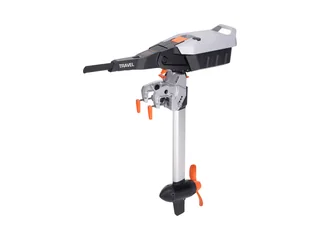
Torqeedo Travel (1100 W, next-gen) — the cruiser default
This is the redesigned Torqeedo Travel that replaced the Travel 1103 C, which Torqeedo no longer sells (the 1103 now appears only in its spare-parts catalog). The core recipe is the same — a quiet 1,100 W direct-drive motor for tenders, dinghies and daysailers up to 1.5 tons — but the details are new: a click-and-play battery with no cables to connect, a backlit color display on the tiller that shows speed, consumption, charge and remaining range in time or distance, and built-in GPS, Bluetooth and Wi-Fi linking to the TorqView app for maps, trip logs and over-the-air updates. The motor weighs 11.6 kg (25.5 lb) without battery; the Essential Package pairs it with a 1,080 Wh battery, and the Range Package's 1,512 Wh battery adds up to 32 percent more range. It remains the most polished integrated-battery outboard in this class and the one we'd point any cruiser at as the default starting place. The catch is the price — the Essential Package is $3,398 from Torqeedo's US store, roughly $600 above the ePropulsion Spirit 1.0 Plus at typical street prices. Whether that's worth it depends on whether you value polish over raw value. For most cruisers who plan to keep the motor a decade, we say yes.
Strengths
- Color tiller display with GPS-calculated remaining range
- TorqView app for live data, trip logs, maps and OTA updates
- Click-and-play battery — no cables to connect
- IP67-rated battery; charges from mains, 12/24 V, or up to 200 Wp of solar direct
- Strongest dealer service network in North America
- 1,512 Wh battery option (Range Package) for up to 32% more range
Trade-offs
- $3,398 for the Essential Package — roughly $600 more than the ePropulsion Spirit 1.0 Plus
- Standard 1,080Wh battery is smaller than ePropulsion's 1276Wh at a higher price
- Spare batteries are pricey ($1,599 for the 1,080 Wh Travel Battery)
- Torqeedo lists no NMEA 2000 output for the Travel — app only
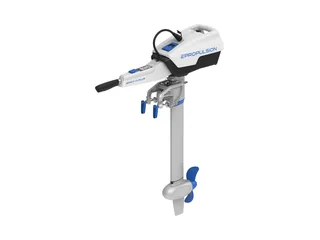
ePropulsion Spirit 1.0 Plus — the value pick
The Spirit 1.0 Plus is the unit that is genuinely making Torqeedo nervous. ePropulsion's pitch is straightforward: nearly identical hardware (brushless DC, integrated lithium-ion battery, IP67 immersion rating, smartphone app for telemetry), about 18 percent more battery capacity (1276Wh versus the Torqeedo Travel's standard 1,080Wh), a 10-year limited warranty on the motor drivetrain (Torqeedo offers two years), all at a price point roughly $600 lower. The trade-off versus Torqeedo is the throttle display, which lacks the GPS-based range estimator built into Torqeedo's Travel display — the ePropulsion display shows you battery percentage and current consumption but doesn't tell you "you have 47 minutes of range remaining at current throttle." For a sailor who already plans by feel, that's fine. For a cruiser who wants the data on the throttle, Torqeedo still wins. Hydrogeneration when the motor is tilted up but in the water (sailing under tow) is built into the Spirit, which is a quiet but real bonus for sailors making long passages.
Strengths
- 1276Wh battery — bigger than the Torqeedo Travel's standard 1,080Wh pack
- 10-year limited warranty on drivetrain — best in category
- Roughly $600 cheaper than the Torqeedo Travel equivalent
- Hydrogeneration when sailing under tow
- Plug-and-play integrated design — one click to assemble
- App-based telemetry, basic but adequate
Trade-offs
- Throttle display lacks GPS-based range estimator
- Dealer network thinner than Torqeedo in North America
- Software updates roll out slightly slower than Torqeedo
- App polish is a step behind Torqeedo's TorqView
Mercury Avator 7.5e — the fishing-boat pick
The Avator 7.5e is Mercury's serious answer to electric, and it shows the engineering pedigree. Real 7.5hp-equivalent thrust (enough to plane a small fishing boat with one or two anglers), modular 1000Wh batteries that snap in like portable drill packs (run one for short outings, two for full days), proper kick-up mount that protects the prop in shallow water, and full integration with Mercury SmartCraft and VesselView MFDs over NMEA 2000. The killer feature for a fishing-boat owner is the dealer network — Mercury has the deepest service footprint in North American outboards, full stop. If something goes wrong, you can get it fixed locally. Torqeedo and ePropulsion you might be shipping the unit to a regional service center. The price is honestly steep — base unit around $5,800 and complete kit with two batteries closer to $7,500 — but for a trailered bass or flats boat where Torqeedo and ePropulsion are simply too light, this is the only electric that genuinely competes with a gas equivalent.
Strengths
- Real 7.5hp-equivalent thrust — actually planes small fishing boats
- Modular batteries — buy one, add a second later
- Native NMEA 2000 + SmartCraft + VesselView integration
- Mercury's North American dealer and service network
- Kick-up mount protects prop in shallow water
- Built for the bass-and-flats fishing market
Trade-offs
- $5,800+ base — significant capital outlay
- Each spare battery roughly $1,500
- Heavier than gas 7.5hp equivalent (battery weight)
- Range on a single battery is short for sustained planing speed
- Charging time on the stock AC charger is 6–8 hours per battery
Two more we considered
The Torqeedo Cruise 3.0 (check price) is Torqeedo's separate-battery 3kW unit aimed at slightly larger sailing auxiliaries (24-30 foot displacement boats). It's a serious motor with proper NMEA 2000 output and works with any 24V or 48V lithium house bank you build separately. We didn't lead with it because the install complexity (separate battery bank, separate charger, separate wiring run, separate fuse panel) puts it in a different category than the integrated-battery Travel. If you're building a serious sailing-auxiliary install and you already plan to commission a dedicated propulsion battery bank, the Cruise 3.0 is the right call — and the right place to start is our marine battery monitor guide for the supporting electronics.
The ePropulsion Navy 3.0 Evo (check price) is ePropulsion's answer to the Cruise 3.0, also separate-battery, 48V. Same trade-off — needs a dedicated lithium pack you commission separately, more install complexity, more capability. The Navy has slightly better hydrogeneration recovery than the Torqeedo equivalent (small but real on long sailing passages). For an owner already committed to a 48V house architecture, this is the cleaner integration.
Integrated vs separate-battery designs — the trade-offs
The single biggest architectural decision in electric outboards isn't motor power. It's whether the battery lives on the motor (integrated) or somewhere else on the boat (separate). Both approaches make sense; they make sense for different boats.
Integrated batteries — Torqeedo Travel, ePropulsion Spirit, Mercury Avator
The battery is part of the motor. You unclip it for charging or storage. The wiring is internal. Installation is essentially: clamp the motor on the transom, plug in the battery, twist the throttle.
The case for integrated: Simplicity. No separate battery bank to commission, no marine 12V or 48V wiring run, no fuse panel work, no risk of voltage compatibility errors when adding a spare. You can take the motor and battery off the boat and store both in your basement over winter — no battery sulfation on a forgotten boat-side install. For a tender or a small sailing auxiliary, integrated is almost certainly the right architecture.
The case against: You're limited to the battery the motor ships with, plus whatever spares the brand sells. The Travel ships with a 1,080Wh battery (1,512Wh in the Range Package) — adding a second pack means buying a $1,599-plus Torqeedo-branded spare. There's no path to "throw 5kWh of lithium in the bilge and run a 1kW outboard all day off it." If you want serious range, integrated is the wrong architecture.
Separate batteries — Torqeedo Cruise, ePropulsion Navy
The motor is just a motor — a brushless DC drive unit with a throttle. The battery bank lives separately, typically in the bilge or under a settee. The motor connects to the bank via heavy cabling sized for the motor's peak amperage draw.
The case for separate: Scalability. Want 2 kWh of capacity? Build a 2 kWh pack. Want 10 kWh? Build a 10 kWh pack. The motor doesn't care. You can also share that bank with house loads via a DC-DC converter, integrate it into your solar charging system, and use the same charger you'd use for any 48V lithium installation. For a serious displacement-cruising sailboat, separate-battery is the only architecture that makes range numbers meaningful.
The case against: Install complexity is real. You're commissioning a high-voltage lithium pack — sometimes 48V or 60V — with the fuse sizing, BMS configuration, charge management, and safety considerations that come with it. Cable runs from motor to bank need to be properly sized and protected. The cost of the supporting electronics (BMS, charger, contactor, fuses) is often $1,500–$2,500 on top of the motor and battery. If you're not comfortable wiring a 48V lithium house bank, hire an ABYC-certified electrician.
Throttle telemetry and chartplotter integration
One quiet but real advantage of electric outboards is the data they generate. A gas outboard tells you fuel level, RPM, and (maybe) coolant temperature. An electric outboard tells you battery percentage, current draw in watts, motor temperature, controller temperature, GPS speed, estimated time remaining, and on Torqeedo's units a real-time range estimate based on present consumption. That's a richer dataset than most chartplotter networks see, and the question is how to surface it.
The Torqeedo TorqView app
TorqView is the most polished telemetry app in this category. The current Travel has GPS, Bluetooth and Wi-Fi built into the motor, and the app gives you a live connection to it, trip analysis with real-time tracking and maps, maintenance info, and over-the-air firmware updates. The tiller display itself already shows speed, consumption, charge and remaining range in time or distance, so the app is for logging and learning rather than for basic operation — use the trip logs to find the efficient throttle setting for your specific boat. Torqeedo lists no NMEA 2000 output for the Travel — the data path is motor → app on your phone. For most owners that's fine, but if you want a permanent helm display you need to leave a tablet mounted on a RAM ball.
The ePropulsion app
ePropulsion's app is functional, slightly less polished than TorqView, but covers the basics — battery percent, watts, GPS speed, trip log. The big practical limitation versus Torqeedo is the lack of an in-app range estimator. You see the data, you draw your own conclusions. For a sailor who plans by feel, this is fine. For a data-driven cruiser who wants the boat to do the estimation, Torqeedo's app still leads.
NMEA 2000 — the Cruise, Navy, and Mercury Avator
This is where the larger electric outboards genuinely differentiate. The Torqeedo Cruise series exposes battery state-of-charge, motor RPM, current draw, and temperature over NMEA 2000 — your chartplotter shows it natively alongside your AIS, depth, and wind. The ePropulsion Navy Evo does the same. The Mercury Avator goes one better and integrates with the full Mercury SmartCraft suite, which means a Mercury VesselView MFD treats the Avator as a first-class engine — full gauges, fault codes, the works.
For an integrated install where the motor data shows up on the helm plotter alongside the rest of the boat's systems, this matters. For more on getting the rest of your boat's systems talking the same language, see our NMEA 2000 gateway guide.
Both Torqeedo and ePropulsion telemetry can be exposed to Home Assistant or Signal K via Bluetooth proxy bridges. The community work here is uneven — Torqeedo has the larger third-party ecosystem — but if you're building a fully connected boat, the motor data is reachable.
Charging — solar from a tender, shore power, and the upgrade path
Charging is where electric outboard ownership lives or dies. A motor that can't be reliably refilled is a motor that becomes a paperweight. The good news: charging an electric outboard is genuinely flexible. The trap: people overestimate how fast solar can refill a battery.
Shore power — the baseline
Every electric outboard ships with a brand AC charger that plugs into a standard household outlet. The Torqeedo Travel ships with a 180W mains charger for its 1,080Wh battery, which can also charge from 12/24V boat power or directly from solar panels up to 200 Wp with Torqeedo's solar charging cable. The ePropulsion Spirit 1276Wh battery is about 7 hours stock, 4 hours with the fast charger. The Mercury Avator 1000Wh batteries are 6–8 hours each. If you keep the boat at a marina with shore power and run the motor 1–2 hours per outing, this is the entire charging story. You plug in when you return, the battery is full by morning, and you never think about charging again.
Solar from a tender or sailboat — the dream and the math
This is where the question gets interesting and where most owners overestimate solar's ability to keep up. A reasonable 300W solar array on a tender hardtop or a sailboat bimini delivers roughly 1.2–1.6 kWh per sunny day in temperate latitudes — enough to refill a Torqeedo Travel battery (1,080Wh) in about a day of sun, or an ePropulsion Spirit (1276Wh) in a day-and-a-half. That math is fine for tender duty where you run the motor an hour and let it recharge for a day. It is not fine for serious daily motor use, where you'd consume 2–3 kWh and only get 1.5 kWh back.
The wiring detail people often miss: most electric outboard batteries do not charge directly from DC solar. They charge through the brand AC charger. So the practical solar path is: solar panels → MPPT charge controller → 12V or 48V house bank → inverter → brand AC charger → outboard battery. That introduces conversion losses at each stage (5-10% inverter, 10-15% AC charger). The realistic recovery is 70-75% of what raw solar produces. For full sizing math, see our solar power for smart boats guide.
A few brands are starting to offer direct-DC charging accessories — the current Torqeedo Travel battery accepts solar panels up to 200 Wp directly through Torqeedo's solar charging cable, and ePropulsion has a DC charger that accepts 12-30V DC input from a house bank, which is meaningfully more efficient. If you're planning a serious solar-charged-outboard install, ask the vendor specifically about DC-input chargers.
Spare batteries — the upgrade path
The cheapest way to double your range, on every integrated-battery design, is to buy a second battery. Spares run $900–$2,000 depending on brand and capacity (Torqeedo's own Travel batteries are $1,599–$1,999). You swap the depleted pack out at lunch, the boat is good for another half day. Two batteries plus a single motor is meaningfully cheaper than upgrading to a higher-power motor with a single bigger battery, and the modularity is genuinely useful — you can charge one at home while the other lives on the boat. For a Mercury Avator owner, a two-battery configuration is essentially mandatory for full-day fishing use.
The shore-power charging speed gotcha
Marina pedestal 30A outlets handle outboard chargers fine. Marina 15A outlets, which are common at smaller club marinas and city docks, do not handle two Mercury Avator chargers simultaneously without tripping. If you're plug-and-charging multiple batteries on a 15A circuit, charge them in sequence not parallel — and budget overnight, not "while you have lunch."
Who should buy what
The decision depends mostly on the boat. The framework is straightforward.
For a cruising sailboat tender
Either the Torqeedo Travel (the 1100 W next-gen model) or the ePropulsion Spirit 1.0 Plus. If you value polish, the dealer network, and the GPS range estimator on the throttle, pick the Torqeedo. If you value about 18 percent more battery capacity, a 10-year warranty, and saving roughly $600, pick the ePropulsion. There is no wrong answer here.
For a small sailing auxiliary (under 22 feet)
Same as above — integrated-battery 1kW is exactly right for short auxiliary bursts (leaving the slip, dropping anchor). Add a second battery if your typical outing exceeds an hour of motor time.
For a serious cruising sailboat (24-30 feet)
The Torqeedo Cruise 3.0 or ePropulsion Navy 3.0 Evo with a properly sized separate lithium bank. This is an architecture decision as much as a motor decision — plan the install with an ABYC-certified electrician.
For a trailered bass or flats boat
The Mercury Avator 7.5e. The other electrics are too light, and Mercury's dealer network is the only one that meaningfully serves the fishing-boat market. Plan for two batteries from day one.
For a daysailor on a no-gas lake
The ePropulsion Spirit 1.0 Plus on price-to-capacity ratio is hard to beat for this exact use case. Charging from a household outlet between weekends is the entire story.
Frequently asked questions
How long do electric outboard batteries actually last per charge?
Range depends heavily on throttle setting. Torqeedo's own figures for the current Travel (1100 W) with its 1,080Wh Essential Package battery are just under 4 hours at slow speed (about 3 knots), about 2 hours at half throttle (about 3.8 knots), and 47–59 minutes at full throttle, measured on a 3.8 m inflatable and a small one-design sailboat. The optional 1,512Wh battery (Range Package) stretches each figure by about a third. ePropulsion's 1276Wh Spirit 1.0 Plus has about 18 percent more capacity than the Travel's standard battery, and range at constant speed scales roughly in proportion. Mercury Avator 7.5e batteries (each 1000Wh) deliver about 45 minutes at full throttle on a small fishing boat; running a single Avator with two batteries roughly doubles that to 90 minutes.
Are electric outboards safe to use in salt water?
Yes — Torqeedo, ePropulsion, and Mercury Avator are all rated for salt-water use. Torqeedo lists the Travel's battery as IP67, and ePropulsion rates the Spirit's motor and battery IP67, meaning brief immersion will not damage them. The rinse-down discipline still matters: after every salt-water outing, fresh-water rinse the motor leg, the throttle, and the battery connectors before storage. Salt residue on contacts is the leading cause of premature failure on otherwise reliable units.
How much horsepower equivalent do I actually need to replace my gas outboard?
Electric outboards quote a "gasoline equivalent" that is generally honest at low and mid throttle but pessimistic at sustained high throttle, where gas engines have a thermal-efficiency advantage. A 1kW electric (roughly 3hp equivalent) genuinely matches a 3hp gas outboard for tender or small-sailboat-auxiliary duty. A Mercury Avator 7.5e (7.5hp equivalent) genuinely pushes the same loads a 7.5hp gas Mercury would. The honest gap shows up in sustained planing speed on heavier boats — for a 16-foot bass boat at full plane, the equivalent gas outboard will deliver more sustained top end than the marketing equivalence suggests.
Can I charge an electric outboard from solar panels on the boat?
Yes, with the right setup. A 300W solar array on a tender's hardtop or a sailboat's bimini delivers roughly 1.2–1.6 kWh per sunny day in temperate latitudes — enough to refill a Torqeedo Travel's 1,080Wh battery in about a day of sun. For a Mercury Avator with multiple 1000Wh batteries, you need either more solar (500–800W) or shore-power top-ups between outings. The wiring detail people miss: most electric outboard batteries charge from the brand's proprietary AC charger, not directly from DC solar. The current Torqeedo Travel is an exception — Torqeedo sells a solar charging cable that takes panels up to 200 Wp straight into the battery. You charge a 12V or 48V house bank from solar, then run the brand AC charger off an inverter. See our solar power for smart boats guide for sizing math.
Will an electric outboard pair with my chartplotter or NMEA 2000 network?
Partially. The current Torqeedo Travel has built-in GPS, Bluetooth and Wi-Fi and connects to Torqeedo's TorqView smartphone app (live motor data, trip logs, maps, over-the-air updates). ePropulsion Spirit and Navy units do the same via the ePropulsion app. Native NMEA 2000 output is available on Torqeedo Cruise series (via an optional cable) and on Mercury Avator, which integrates with Mercury SmartCraft and selected MFDs. For a Torqeedo Travel on a small sailboat, the realistic answer today is "use the app on your phone, not the plotter."
Are electric outboards actually cheaper to operate than gas long-term?
Fuel cost is dramatically lower — running a 1kW electric for an hour costs roughly $0.15 in shore-power electricity versus $4–6 in gasoline for an equivalent 3hp gas outboard. Maintenance is also lower: no oil changes, no winterization, no fuel stabilizer, no spark plugs, no impellers in most designs. The honest accounting is that the up-front price premium (2–3x a gas equivalent at small horsepowers) only breaks even after several hundred operating hours. If you log under 20 hours a year of outboard time, the gas math still wins on lifetime cost — buy electric for noise, smell, and reliability reasons instead.
The short version, by profile
Cruising sailor with a tender and solar on the bimini: Torqeedo Travel (1100 W, next-gen) for polish and TorqView telemetry, or ePropulsion Spirit 1.0 Plus for about 18 percent more battery and roughly $600 saved. Both are correct answers — pick the one whose trade-off bothers you less.
Small sailing auxiliary owner (under 22 ft): Same two units. The integrated-battery 1kW class is exactly the right tool for short auxiliary use, and the install is genuinely "clamp on, plug in, go." Plan a spare battery (spare batteries) for any outing over an hour of motor time.
Serious cruising sailboat (24-30 ft): Torqeedo Cruise 3.0 or ePropulsion Navy 3.0 Evo with a properly sized separate 48V lithium pack. This is a system commissioning project, not a motor purchase — work with an ABYC-certified electrician and budget the supporting electronics into the total cost.
Trailered bass or flats boat owner: Mercury Avator 7.5e with two batteries from day one. The Mercury dealer network is the difference here — nothing else electric meaningfully serves the fishing-boat market with local service yet. Add a proper kick-up mount if your boat doesn't ship with one.
The general rule: if you log under 20 hours of motor time per year, electric is bought for the quietness and reliability, not for the lifetime cost savings. If you log over 100 hours, the operating-cost gap genuinely pays for the price premium within a few years. Either way, integrated batteries for tenders and small sailing auxiliaries, separate batteries for serious cruising boats.